How a Secured Credit Card Works: Deposit, Fees and Moving Up

A secured credit card works like a regular credit card with one difference: before you can use it, you put down a cash deposit that backs your credit limit. Because the deposit lowers the issuer's risk, these cards are often easier to get when you have no credit history or are rebuilding after problems. Used well, the account can build the same kind of payment record as an unsecured card. Used carelessly, it can cost more in fees than it gives back.
How the deposit works
With most secured cards, your credit line starts out small and you deposit an amount equal to it, according to the CFPB. The Federal Trade Commission puts it slightly differently: you usually deposit a percentage of your credit limit, possibly as much as 100%, so the issuer knows it will be paid even if you miss a payment. Some issuers offer a limit higher than the deposit to applicants who qualify, which makes the card partly secured from the start (myFICO).
A few points about the deposit are easy to miss:
- It is not spending money. You can't use the deposit to pay your bill or make purchases (myFICO). Otherwise the card works like an unsecured one: you get a bill, and a balance you carry past the due date can be charged interest.
- It is collateral. If you don't pay, the issuer may keep the deposit and close the account (myFICO).
- It is tied up until you move on. You are without that money until you close the account or the issuer converts it to an unsecured card (myFICO).
- The size varies. myFICO, citing the CFPB, says most secured card deposits fall between $50 and $300, and some cards accept deposits as high as $5,000 for a larger limit.
Your legal protections are the same as on any credit card. The FTC notes that a secured card caps your liability for unauthorized use at $50 and gives you the right to dispute many kinds of billing errors.
How a secured credit card shows up on your credit reports
According to myFICO, FICO Scores "look at secured cards the same as any credit card," and most banks that offer them report the activity to the credit bureaus. "Most" is not "all," though, and an account that isn't reported can't help your scores. Before you apply, confirm that the issuer reports to all three nationwide bureaus: Equifax, Experian and TransUnion.
If you are starting from scratch, expect to wait. To produce a FICO Score, you need at least one account that has been reporting to at least one major bureau for six months or more.
The small limit makes credit utilization, the share of your available credit you are using, easy to push up. Your credit report usually shows the balance from your latest statement, so a balance you pay in full a few days later can still appear (myFICO). The CFPB notes that some experts suggest keeping utilization under 30% of your total limit and others under 10%.
Here is how a secured card compares with the cards it is most often confused with:
| Secured credit card | Unsecured credit card | Prepaid card | |
|---|---|---|---|
| Money up front | A deposit, often equal to the limit | None | You load your own money |
| Are you borrowing? | Yes, up to the limit | Yes, up to the limit | Usually not |
| Interest | On balances you carry | On balances you carry | None on the loaded money |
| Builds credit history? | Yes, if the issuer reports it | Yes, if the issuer reports it | Most aren't reported |
The FTC says most prepaid cards are not reported to the credit bureaus, and the CFPB adds that because you only spend money you deposited in advance, prepaid cards don't establish a credit history.
Fees to check before you apply
The FTC notes that secured cards generally, though not always, carry higher APRs and higher annual fees than unsecured cards, and some add activation or monthly maintenance fees. Every fee charged to the card eats into the credit you can actually use. myFICO adds that you should look for a grace period on purchases and steer clear of cards with a penalty APR. If you are not sure how those work, see our guide to credit card APR.
Two federal rules set limits worth knowing:
- A first-year fee cap. In the first year after the account opens, the fees you are required to pay can't add up to more than 25% of the starting credit limit (Regulation Z, § 1026.52). Late fees, over-the-limit fees and returned-payment fees don't count toward the cap. Neither does a security deposit, as long as it isn't charged to the card account itself.
- An available-credit disclosure. If the required fees or deposit charged to the account at opening reach 15% or more of the minimum credit limit, the issuer must show in its rate table how much credit you would have left (Regulation Z, § 1026.60).
Worked example: two cards with a $300 deposit
Suppose you are choosing between two secured cards, and each would give you a $300 limit for a $300 deposit.
- Card A has no annual fee and no monthly fee.
- Card B charges a $29 annual fee to the account when it opens, plus a $3 monthly maintenance fee.
Card B's first-year fees come to $29 + (12 × $3) = $65, which is 21.7% of the $300 limit. That is under the $75 cap (25% of $300), so it is allowed. Once the $29 fee posts, your available credit drops to $271, and the fee itself counts as a balance: 9.7% of your limit before you have bought anything.
Now think about utilization. Staying under 30% of a $300 limit means a statement balance of $90 or less; staying under 10% means $30 or less. On Card B, the annual fee alone uses most of that 10% room until you pay it off.
Assume you graduate or close either account in good standing a year later. You get your $300 back in both cases, but the fees are gone: Card A cost you $0 for the year and Card B cost $65.
Questions to ask an issuer
- Do you report this card to Equifax, Experian and TransUnion?
- What are the annual, monthly, setup and activation fees, and are any charged to the card at opening?
- What is the purchase APR, and is there a grace period on purchases?
- Is there a penalty APR?
- What is the minimum deposit, and can I add more for a higher limit?
- Do you review accounts for an upgrade to an unsecured card, and after how long?
- How and when do I get my deposit back?
How to move from a secured card to an unsecured card
Moving up, often called graduating, can happen in two ways. Some cards promise to consider you for a higher line that is only partly backed by your deposit, or for a fully unsecured version with your deposit refunded, after a certain number of on-time payments (myFICO). The CFPB describes the same path: as you show you can pay on time, your limit may go up and your deposit may come back to you.
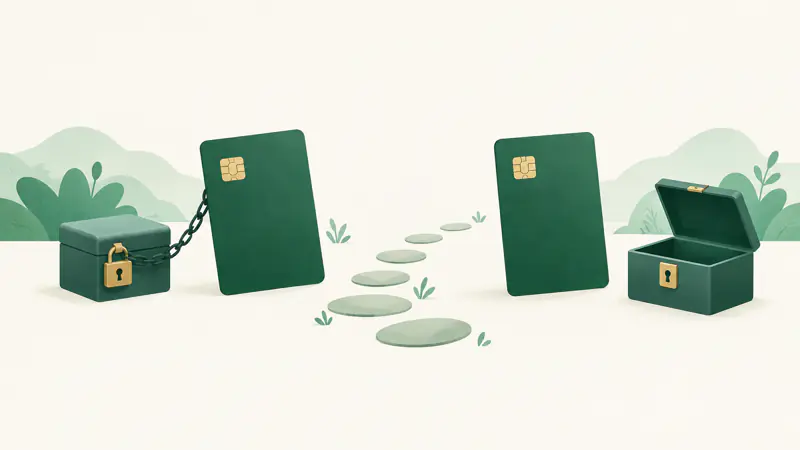
Other cards have no clear upgrade path, and the only way to recover the deposit may be to close the account. The FTC says you usually get the deposit back once you pay off the balance and close the account. Closing has trade-offs of its own: it lowers your total available credit, which can raise your utilization ratio (CFPB). If you are weighing that step, our checklist for closing a credit card walks through it.
Applying for a separate unsecured card is the other route. Keep the timing in mind: the CFPB notes that applying for or opening many new accounts in a short time may lower your score.
A simple first-year routine
The habits that make a secured card worth its fees are the same ones that matter on any card:
- Put one small recurring bill on the card, such as a streaming subscription, which is the approach myFICO suggests for keeping utilization low while the account stays active.
- Set up automatic payment of the full statement balance so you never pay late or carry interest.
- Check each statement to see the balance that will likely be reported.
- After six months, ask whether the issuer will review the account for a higher limit or an upgrade.
- Before you close anything, check the effect on your available credit.
Rewards shouldn't drive the choice at this stage. myFICO points out that many secured cards offer little or no rewards and that rewards probably shouldn't be your priority while you build credit. A low-fee card that reports to all three bureaus does the job.
Sources
- Federal Trade Commission — Comparing credit, charge, secured credit, debit, or prepaid cards
- Consumer Financial Protection Bureau — How to rebuild your credit
- Consumer Financial Protection Bureau — What are some ways to start or rebuild a good credit history?
- myFICO — Best ways to build and improve your credit score
- myFICO — How can I start building my credit history?
- myFICO — What should you look for in a secured credit card?
- myFICO — Options when you're building credit
- myFICO — How credit history length affects your FICO Score
- myFICO — How owing money can impact your credit score
- Consumer Financial Protection Bureau — Regulation Z § 1026.52, Limitations on fees
- Consumer Financial Protection Bureau — Regulation Z § 1026.60, Credit and charge card applications and solicitations
- Consumer Financial Protection Bureau — Can my credit card company change the terms of my account?
 Credit Card APR Explained: Rates, Daily Interest and the Grace Period
 0% Intro APR Balance Transfer Credit Cards: Fees, Deadlines and the Math
 Cash Back vs Travel Rewards Credit Cards: How to Compare Them
 Is a Credit Card Annual Fee Worth It? How to Find Your Break-Even
 How to Dispute a Credit Card Charge: Deadlines, Letter and Your Rights
 Authorized User on a Credit Card: Who Owes the Debt and How It's Reported
 How to Stop Recurring Charges on a Credit Card