Credit Card APR Explained: Rates, Daily Interest and the Grace Period
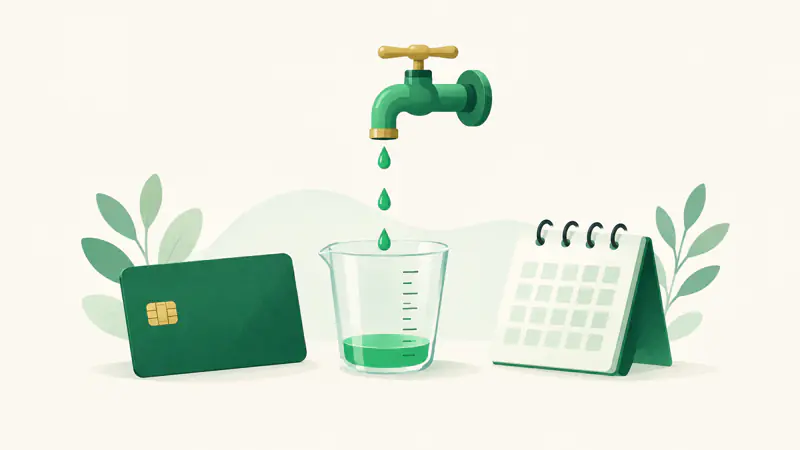
Your credit card APR is the yearly interest rate your card charges on money you borrow and don't repay by the due date. Most cards carry several APRs at once, and the interest itself is usually worked out day by day, so two people with the same rate can pay very different amounts. This guide covers the types of APR, how the daily calculation works, and how the grace period lets you avoid interest on purchases.
What APR means on a credit card
The Consumer Financial Protection Bureau (CFPB) describes a card's interest rate as the price you pay to borrow and notes that card rates are usually stated as a yearly figure: the annual percentage rate, or APR. Your card company has to disclose the APR before you agree to use the card, according to the CFPB's list of credit card key terms.
Two details shape what you actually pay:
- Several APRs on one account. Different rates can apply to different balances, such as purchases and cash advances, and each balance's own APR is used to calculate its interest (CFPB contract definitions).
- Fixed or variable. A variable APR moves with an index, such as the prime rate. A fixed APR does not follow an index, but it can still change: the issuer generally has to notify you first and, in most cases, can apply a higher rate only to transactions you make after the notice (CFPB).
The types of credit card APR
The rate table you see when you apply, and your card agreement, list each rate separately. These are the ones you are most likely to meet:
| APR type | What it applies to | What to watch |
|---|---|---|
| Purchase APR | Goods and services you buy with the card | Most cards give a grace period on purchases if you pay in full |
| Balance transfer APR | Debt moved from another card | Often a promotional rate for a limited time, plus a transfer fee |
| Cash advance APR | ATM cash and cash equivalents | Usually higher than the purchase rate; interest starts right away |
| Penalty APR | New transactions after a trigger such as a late payment | Can reach existing balances once you are more than 60 days late |
| Introductory APR | A temporary low rate on purchases, transfers or both | Must last at least six months; check the rate that follows |
Cash advance APR
Getting cash from an ATM with a credit card is treated as a short-term loan, and the CFPB warns that it can be expensive. You usually pay a higher rate than on purchases, and there is no grace period: interest starts as soon as you take the money. Some transactions treated as cash equivalents, such as buying cryptocurrency, sending peer-to-peer money transfers or buying lottery tickets, can also set off a cash advance fee.
When the CFPB looked at card agreements from seven large issuers for a December 2024 data spotlight, most set the cash advance fee at the "greater of $10 or 5%," and the most common cash advance APR was 30%. Suppose you take a $300 cash advance on a card with those terms and repay it 20 days later. The fee is $15 (5% of $300), and interest is $300 × 30% ÷ 365 × 20 = $4.93, for a total of $19.93. On a $100 advance, the $10 minimum fee alone is 10% of the amount.
Penalty APR
A penalty APR is a higher rate that can kick in after events named in your agreement, such as a late payment or going over your credit limit. Federal rules require the issuer to show the penalty rate, what triggers it and how long it can last in the rate table it gives you with an application (Regulation Z, § 1026.60). The CFPB's explanation of when your rate can rise lists the main limits:
- During the first year of the account, the issuer generally can't raise the rate on new transactions.
- After that, it generally has to give 45 days' notice before raising the rate on new purchases.
- It can raise the rate on your existing balance only in specific cases, one of which is not receiving your minimum payment within 60 days after the due date.
- If your rate went up because you were more than 60 days late, the issuer must bring back your old rate once you make six consecutive on-time minimum payments after the increase.
How credit card interest is calculated
Many issuers figure interest daily from your average daily balance, says the CFPB. Three pieces fit together:
- Daily periodic rate. Your APR divided by 365 or 360, depending on the issuer (CFPB). A 24% APR divided by 365 is about 0.0658% a day.
- Average daily balance. For each day of the billing cycle, the issuer takes the balance, adds new charges and subtracts payments and credits. It adds up those daily balances and divides by the number of days in the cycle.
- Interest for the cycle. The daily rate times the average daily balance times the number of days in the cycle.
When a daily rate is used, each day's interest is typically added to the balance, so interest compounds daily. Balances with different APRs are tracked separately, and your statement must show each category and how much of your balance falls in it.
Worked example: one 30-day billing cycle
Suppose your card has a 24% purchase APR, your issuer divides by 365, and you carried $1,500 into a 30-day billing cycle, so you have no grace period this month.
- Days 1–10: the balance is $1,500.
- Day 11: you buy something for $600, so days 11–20 sit at $2,100.
- Day 21: you pay $500, so days 21–30 sit at $1,600.
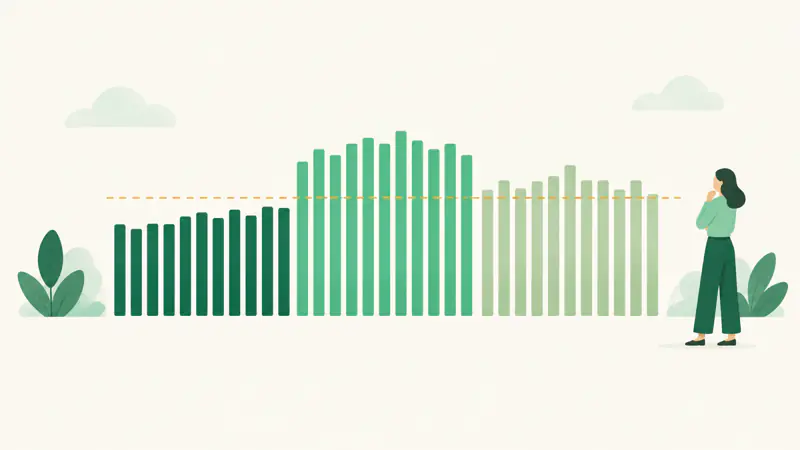
The daily balances add up to $52,000 (10 × $1,500 + 10 × $2,100 + 10 × $1,600). Divided by 30 days, the average daily balance is $1,733.33. Interest for the cycle is $1,733.33 × (24% ÷ 365) × 30 = $34.19. If your issuer compounds daily, adding each day's interest to the next day's balance, the total comes to $34.52.
Timing matters. Make the same $500 payment on day 6 instead of day 21 and the daily balances add up to $44,500, the average falls to $1,483.33 and interest drops to $29.26, about $4.93 less for the same dollars. That is why the CFPB notes that, without a grace period, the sooner you pay, the less interest you pay.
How the grace period works
A grace period is the stretch between the end of a billing cycle and your payment due date. If you pay the full balance by the due date, you may owe no interest on purchases (CFPB). Issuers don't have to offer one, but most cards have a grace period on purchases, and card companies must have procedures to get your bill to you at least 21 days before the payment is due.
The rules that trip people up:
- The grace period usually covers only new purchases, and only when you aren't already carrying a balance.
- Cash advances and checks from your card issuer generally start charging interest on the transaction date.
- If you don't pay in full, you are charged interest on the unpaid part, and new purchases accrue interest from the day you make them.
- Paying in full only in some months can cost you the grace period for the month you fall short and for the month after.
The same logic applies when you move debt onto a card: new purchases on a card that holds a transferred balance usually don't get a grace period until the whole balance is paid, as our guide to balance transfer credit cards explains.
How your payments are applied across APRs
When you pay more than the minimum, the issuer generally must apply the extra to the balance with the highest APR first, then to the others in descending order of rate (CFPB). It is up to the issuer where the minimum portion goes. So if you carry a cash advance at 30% and purchases at 24%, only the part of your payment above the minimum is sure to reach the costlier balance first.
The average credit card APR: the Federal Reserve figure
The Federal Reserve publishes average card rates in its consumer credit release, known as G.19. In the release of October 7, 2026, the average APR for August 2026, a preliminary figure, was 22.36% on credit card accounts that were assessed interest and 21.19% across all accounts. The two differ because the all-accounts figure averages the stated APR on every account, while the other is calculated from the finance charges on accounts that were actually charged interest, relative to their average daily balances. These averages move from release to release, so treat them as context, not as the rate you will be offered.
Ways to pay less interest
The CFPB's Know Before You Owe material points out that if you carry a balance even some of the time, a lower APR will cost you less. Its suggestions for cutting interest you can't avoid:
- Pay on time, and pay more than the minimum.
- Pay before the due date if you can.
- Avoid high-APR transactions such as cash advances.
- Compare APRs when you shop for a card.
Rewards don't change this math much: myFICO cautions that interest on a balance carried from month to month can quickly cancel out what the rewards are worth. Our comparison of cash back vs travel rewards credit cards runs the numbers for people who do pay in full.
Key takeaways
- Your credit card APR is a yearly rate, but interest is usually charged daily on your average daily balance.
- One card can carry separate purchase, balance transfer, cash advance, penalty and introductory APRs.
- Cash advances have no grace period and often carry both a fee and a higher APR.
- Paying in full by the due date keeps the grace period on purchases; when you carry a balance, paying earlier in the cycle lowers interest.
- In the Federal Reserve's October 7, 2026 release, accounts assessed interest averaged a 22.36% APR for August 2026.
Sources
- Consumer Financial Protection Bureau — What is a credit card interest rate? What does APR mean?
- Consumer Financial Protection Bureau — Credit cards key terms
- Consumer Financial Protection Bureau — Credit card contract definitions
- Consumer Financial Protection Bureau — What is the difference between a fixed APR and a variable APR?
- Consumer Financial Protection Bureau — Can I withdraw money from my credit card at an ATM?
- Consumer Financial Protection Bureau — Data Spotlight: Credit card cash advance fees spike after legalization of sports gambling (2024)
- Consumer Financial Protection Bureau — Regulation Z § 1026.60, Credit and charge card applications and solicitations
- Consumer Financial Protection Bureau — When can my credit card company increase my interest rate?
- Consumer Financial Protection Bureau — How does my credit card company calculate the amount of interest I owe?
- Consumer Financial Protection Bureau — What is a "daily periodic rate" on a credit card?
- Consumer Financial Protection Bureau — What is a grace period for a credit card?
- Board of Governors of the Federal Reserve System — Consumer Credit G.19, release of October 7, 2026
- Consumer Financial Protection Bureau — Know Before You Owe: Credit cards
- myFICO — Understanding the different types of credit cards
 How a Secured Credit Card Works: Deposit, Fees and Moving Up
 0% Intro APR Balance Transfer Credit Cards: Fees, Deadlines and the Math
 Cash Back vs Travel Rewards Credit Cards: How to Compare Them
 Is a Credit Card Annual Fee Worth It? How to Find Your Break-Even
 How to Dispute a Credit Card Charge: Deadlines, Letter and Your Rights
 Authorized User on a Credit Card: Who Owes the Debt and How It's Reported
 How to Stop Recurring Charges on a Credit Card