How to Budget on Irregular Income

When you budget on irregular income, the standard advice of "take your monthly pay and divide it up" breaks down, because the number at the top changes every month. Freelancers, gig workers, commission-based salespeople and seasonal workers all face the same problem: a good month invites overspending, and a slow month arrives before the bills are covered.
The fix is to stop budgeting from whatever came in this month. You build your plan on a low month, pay yourself a steady amount from a buffer, and set aside fixed percentages for taxes and savings from every payment.
Why irregular income needs its own plan
Uneven pay is common. In the Federal Reserve's survey of household finances for 2025, 30 percent of adults had income that varied at least occasionally during the year, and 11 percent said they had struggled to pay bills in the prior 12 months because their income varied.
Self-employment makes it more likely:
| Group (2025) | Income varied month to month | Struggled to pay bills because income varied |
|---|---|---|
| Self-employed adults | 58% | 22% |
| Adults who worked for someone else | 28% | 10% |
The CFPB acknowledges that saving can feel difficult when you aren't paid the same amount each week or month, and notes that even a small amount can give you some financial security. The steps below are built around that.
Step 1: Look back 12 months
Pull your last year of income from bank statements or invoices. Suppose you freelance, and your monthly income after business expenses, before taxes, looked like this:
| Month | Income | Month | Income |
|---|---|---|---|
| Jan | $4,200 | Jul | $4,100 |
| Feb | $3,400 | Aug | $7,400 |
| Mar | $5,900 | Sep | $5,000 |
| Apr | $4,800 | Oct | $4,300 |
| May | $6,500 | Nov | $6,300 |
| Jun | $3,600 | Dec | $4,500 |
The year totals $60,000, an average of $5,000 a month. But the average never actually arrives: the range runs from $3,400 in February to $7,400 in August. A budget built on $5,000 would come up short in seven of the twelve months.
Use income after business costs, such as software, supplies or mileage, because that money was never yours to spend. If your business costs are large or vary a lot, run them through a separate account so they don't blur the picture of what you earned. If you have less than a year of history, use what you have and plan more cautiously until a full year builds up.
Step 2: Split every payment by percentage
Instead of saving a fixed dollar amount, take the same percentages from every payment the day it arrives. In this example:
- 25% to a tax account. This is a placeholder for the example, not a recommended rate. Your actual tax depends on your income, deductions and credits (see step 5).
- 10% to savings. That is $340 from February's income and $740 from August's, and $6,000 over the year.
- 65% to a holding account that pays your living expenses.
Percentages scale with your income, so saving never takes more than a slow month can afford, and a strong month automatically saves more.
Step 3: Build a bare-bones budget on your baseline month
Your baseline is what reaches the holding account in a low month. In February, 65% of $3,400 is $2,210. Your essential expenses need to fit inside that number:
| Essential expense | Monthly cost |
|---|---|
| Rent | $1,100 |
| Utilities | $140 |
| Groceries | $380 |
| Health insurance | $260 |
| Transportation | $160 |
| Phone and internet | $90 |
| Minimum debt payments | $70 |
| Total essentials | $2,200 |
If your essentials don't fit in your baseline, that's a warning sign. You need either lower fixed costs or a larger buffer before you smooth your pay.
Step 4: Smooth your pay with a buffer
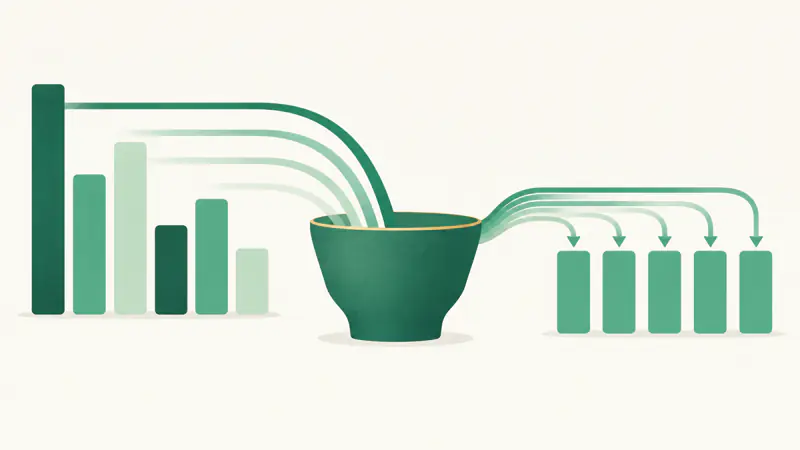
Now pay yourself a fixed "salary" from the holding account on the same day each month. Pick an amount the average can support. Over the year, 65% of $60,000 is $39,000, or $3,250 a month. A salary of $3,100 covers the $2,200 of essentials plus $900 for flexible spending and still leaves room to grow the buffer.
Starting with one month's salary ($3,100) in the holding account, the first half of the year looks like this:
| Month | Income | 65% to holding | Salary paid | Holding balance |
|---|---|---|---|---|
| Jan | $4,200 | $2,730 | $3,100 | $2,730 |
| Feb | $3,400 | $2,210 | $3,100 | $1,840 |
| Mar | $5,900 | $3,835 | $3,100 | $2,575 |
| Apr | $4,800 | $3,120 | $3,100 | $2,595 |
| May | $6,500 | $4,225 | $3,100 | $3,720 |
| Jun | $3,600 | $2,340 | $3,100 | $2,960 |
February is the low point at $1,840. By December the balance reaches $4,900, $1,800 more than you started with. If you don't have a month's salary saved yet, pay yourself your baseline ($2,210 in this example) until the buffer builds.
The buffer also shows you when to act. Suppose two months in a row bring in only $3,400. Each month, $2,210 reaches the holding account and the $3,100 salary takes $890 more than that, so a $3,100 buffer falls to $1,320. That is your signal. Set a floor, such as half a month's salary ($1,550 here; in the year shown above, the balance never falls that low), and when the balance drops under it, switch to the bare-bones budget, cut the salary to the baseline and look for more work before the buffer runs out.
Within each month, you can plan the salary with any method. A zero-based budget works well because the salary is the same every month. A 50/30/20 budget works too, once the salary is steady.
The buffer is not your emergency fund. It evens out normal ups and downs; the emergency fund covers job loss and big surprises. With variable pay, a larger emergency fund makes sense; see how much to save in an emergency fund.
Step 5: Plan quarterly estimated taxes if you're self-employed
No employer is withholding tax from your pay, so the tax account has a job to do. According to the IRS, tax must be paid as you earn income during the year, through withholding or estimated tax payments, and people in business for themselves generally need to make estimated payments. Individuals generally must make them if they expect to owe $1,000 or more when they file.
Estimated tax covers more than income tax. It also covers self-employment tax, which the IRS describes as Social Security and Medicare taxes for people who work for themselves. The rate is 15.3%: 12.4% for Social Security and 2.9% for Medicare. You owe it if your net earnings from self-employment were $400 or more.
The year is split into four payment periods, and they are not equal in length (IRS). Here is how the example's 25% tax account fills in each one:
| Payment period | Due date | Income in period | 25% set aside |
|---|---|---|---|
| Jan. 1–March 31 | April 15 | $13,500 | $3,375 |
| April 1–May 31 | June 15 | $11,300 | $2,825 |
| June 1–Aug. 31 | Sept. 15 | $15,100 | $3,775 |
| Sept. 1–Dec. 31 | Jan. 15 of the following year | $20,100 | $5,025 |
If a due date falls on a weekend or legal holiday, a payment made on the next business day is on time. A few other IRS rules matter when income is uneven:
- You can pay weekly, every two weeks or monthly if that's easier, as long as you've paid enough by the end of each quarter.
- Most taxpayers avoid the underpayment penalty if they owe less than $1,000 after withholding and credits, or if they paid at least 90% of this year's tax or 100% of last year's, whichever is smaller. Special rules apply to farmers, fishermen and certain higher-income taxpayers.
- If your income arrives unevenly, annualizing it and making unequal payments may avoid or lower a penalty. Form 2210 is used to check.
- You may owe a penalty for a late or short payment even if you are due a refund when you file.
To figure the amount, the IRS points to the worksheet in Form 1040-ES and suggests using last year's return as a starting point. If your income turns out higher or lower than you expected, you can redo the worksheet for the next quarter. Quarterly taxes are, in effect, a sinking fund with four due dates a year.
Handling high and low months
- High months: don't raise your salary. Let the buffer grow, and consider adding extra to savings. The CFPB suggests saving when you have more money, since some weeks will be tighter than others.
- Low months: keep paying the same salary from the buffer. If the buffer falls below your floor, drop to your bare-bones budget until it recovers.
- Bill timing: if bills cluster in the weeks when money is short, the CFPB says you can ask creditors and utility companies for due dates that line up better with your income.
- Once a year: recheck your baseline and salary against the latest 12 months, and raise the salary only if the buffer has grown steadily.
Sources
- Federal Reserve Board — Economic Well-Being of U.S. Households in 2025: Income and Expenses
- Consumer Financial Protection Bureau — An essential guide to building an emergency fund
- Consumer Financial Protection Bureau — Get money smart: 25 tips to improve your financial well-being
- Internal Revenue Service — Estimated taxes
- Internal Revenue Service — Estimated tax (frequently asked questions)
- Internal Revenue Service — Self-employment tax (Social Security and Medicare taxes)
 The 50/30/20 Budget: How It Works, With a Worked Example
 How to Make a Zero-Based Budget, With a Monthly Example
 How Much to Save in an Emergency Fund
 Sinking Funds: How to Save Monthly for Irregular Expenses
 Financial Milestones by Age: A Decade-by-Decade Money Checklist
 Emotional Spending: How to Spot Your Triggers and Slow Down
 How a Joint Bank Account Works for Couples
 How to Budget for Concert Tickets and the True Cost of a Show
 Pay Yourself First: How to Automate Saving From Every Paycheck
 How to Set Financial Goals and Work Out the Monthly Amount
 How to Track Your Spending, With a 30-Day Example
 How to Make a Travel Budget, Line by Line
 Side Hustle Taxes: How Much to Set Aside From Each Payment
 How to Budget for In-Game Purchases: A Guide for Parents