Emotional Spending: How to Spot Your Triggers and Slow Down

When you buy something to change how you feel, such as calming stress, filling a boring evening, celebrating or keeping up with friends, rather than because it was in your plan, that's emotional spending. The practical answer isn't to stop spending on things you enjoy. It's to learn your triggers, put a short pause between the feeling and the purchase, and give yourself a set amount of planned fun money.
This guide covers the common triggers, how to find your own pattern in your statements, a worked example of how small purchases add up, tactics that slow you down at checkout and what to do if the spending has landed on a credit card.
What emotional spending is
Feelings are part of every money decision. The CFPB describes people making financial decisions based on their attitudes, values, emotions, social norms and contextual cues, from splurging on a treat to how much to save in a retirement account.
So the question isn't whether emotion plays a role. It's whether a purchase fits a plan you made with a clear head. A useful test: would you still buy it tomorrow, at the same price, in a calm mood? If yes, it's probably a want you've budgeted for. If the urge fades, the purchase was doing an emotional job.
Unplanned buying is common. The CFPB cites consumer marketing research in which nine out of ten shoppers report that they frequently buy items not on their shopping lists. It becomes a money problem when it crowds out bills and savings: the CFPB notes that when people overspend, they may have to dip into savings or borrow money, sometimes at a high cost, to cover the difference.
Common emotional spending triggers
Triggers come from inside, as a feeling, and from outside, as people, ads and deals. The CFPB says a person's money choices are affected by the people close to them, as well as by their future goals and their financial reality.
| Trigger | What it can look like | A counter-move |
|---|---|---|
| Stress | Delivery after a hard day, a late-night "I deserve it" order | Keep an easy, low-cost default meal at home |
| Boredom | Browsing shopping sites with no list | Remove saved card details so checkout takes effort |
| Celebration | A raise or bonus spent over one weekend | Decide the fun share of any windfall in advance |
| Social pressure | Group dinners, trips and gifts you feel you can't skip | Set a per-event limit or suggest a cheaper plan |
| Urgency | "Today only" deals, countdown timers | Put the item on a waiting list |
Urgency is often designed in. In a September 2022 report on manipulative design, the FTC described countdown timers designed to make consumers believe they only have a limited time to buy when the offer is not actually time-limited.
A discount doesn't make an unplanned purchase planned. As the CFPB puts it, if you rush to a sale to get a $3,000 TV for $2,000, you've still spent $2,000.
How to spot your pattern in your statements
You don't need to remember every mood. Your bank and card statements already hold the evidence.
- Pull two or three months of statements for every account you spend from, including cards you use for online orders.
- Mark each purchase that wasn't planned. Leave rent, bills and your usual grocery run alone.
- Note the day and time next to each marked purchase, and what was going on if you remember.
- Look for clusters. Common ones are late evenings, payday weekends, the day after a stressful meeting or the week of a group event.
- Run it forward for a month. Each time you make an unplanned purchase, write one word for how you felt: tired, bored, happy, left out.
After a month, most people can name their top one or two triggers. If you don't have a system for logging purchases yet, our guide on how to track your spending sets one up.
How small purchases add up: a worked example
Suppose your statement review turns up these unplanned purchases in a typical month:
| Unplanned purchase | Times a month | Cost each | Monthly total |
|---|---|---|---|
| Takeout after stressful workdays | 6 | $15 | $90 |
| Late-night online orders when bored | 3 | $28 | $84 |
| Treats after a good week | 2 | $35 | $70 |
| Group outing you didn't want to skip | 1 | $60 | $60 |
| Total | 12 | $304 |
That's 12 purchases averaging about $25 each, none of them big enough to feel like a decision. Over a year, they come to $3,648.
Now suppose you set a $150 fun-money line in your budget and send anything beyond it to a waiting list. If unplanned spending stayed within that line, $154 a month, or $1,848 a year, would be free for savings or debt. The other $150 is still $1,800 a year of spending, but spending you chose on purpose.
Tactics that put a pause before the purchase
Use a waiting list
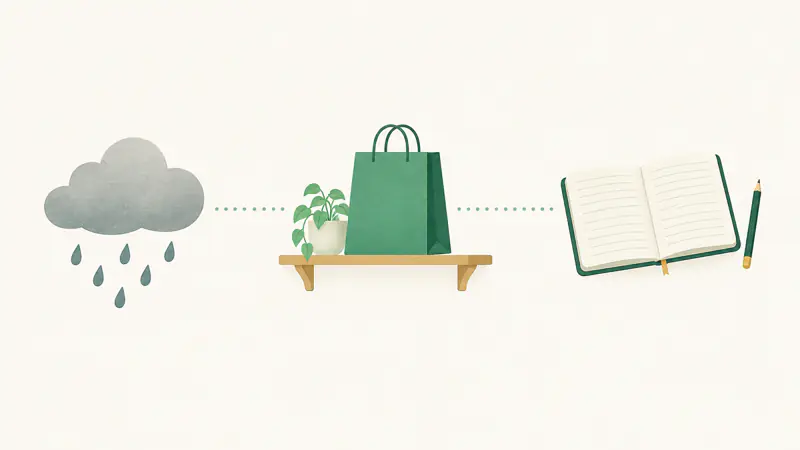
The CFPB suggests a simple alternative to an impulse purchase: make a note of the product, where you saw it and how much it was, check your spending plan, and come back for it if there's room. Pick a waiting period that fits the price, such as a day for small items and a week for larger ones. Many urges are gone by the time the wait ends.
Give fun money its own line
A planned "fun money" amount turns some emotional spending into budgeted spending. In a 50/30/20 budget it sits inside the wants share; in a zero-based budget it's a category like any other. The CFPB advises that if you know you're prone to impulse spending, you create a plan that's doable to help you limit it, and notes that rewarding yourself, even in small ways, can help you keep up your progress.
Check what's left in the line before you buy. When the CFPB talked with consumers, they said spending feedback tools could help them curb impulse spending.
Add friction at checkout
- Remove saved card details from shopping sites, apps and your browser, so every purchase means typing in a card number.
- Turn off one-click or one-tap buying where a site lets you.
- Carry only what you plan to spend. The CFPB's five-step spending plan suggests bringing only the amount of money you plan to spend, so once it's gone, you're done.
Cut the prompts
- Unsubscribe from promotional emails. The FTC notes that many email providers have features that help you unsubscribe from email lists, often shown as a banner or button when you open the email.
- Turn off shopping app notifications and sale alerts.
- Set a personal rule. One the CFPB offers: if something isn't on your list, don't buy it.
Get support
The CFPB suggests developing a support system of family and friends you trust, either to do a budget with you or to listen when you're struggling. Telling a friend about your waiting list makes it easier to keep.
When emotional spending ends up on a credit card
Unplanned purchases cost more when they ride on a card balance you don't pay in full. The CFPB explains that if you lose your grace period by not paying your balance in full by the due date, you will be charged interest on the unpaid portion, and on new purchases starting on the date each purchase is made.
If the balance has grown:
- Stop adding to it. Take the card out of saved checkouts and pay for fun money with debit or cash.
- Act early if you can't pay. The CFPB says to contact your card company immediately; many are willing to work with you to change your payment if you're facing a financial emergency.
- Consider credit counseling. Many credit counseling organizations are nonprofits. Before you sign up, ask whether you'll be charged, how much and what services you'll get.
- Be wary of debt settlement offers. A debt settlement company is not allowed to collect fees before settling or resolving your debt.
Key takeaways
- Emotional spending is buying to change a feeling rather than to follow a plan.
- Stress, boredom, celebration, social pressure and urgency are common triggers.
- Your statements show your pattern: mark unplanned purchases and look for clusters by time and situation.
- A waiting list, a planned fun-money line and less stored payment information all add a pause.
- If the spending is on a card you can't pay off, contact the card company early.
Sources
- Consumer Financial Protection Bureau — Financial habits and norms
- Consumer Financial Protection Bureau — Money motivations
- Consumer Financial Protection Bureau — Managing your spending to achieve your goals
- Consumer Financial Protection Bureau — Plan your spending to avoid holiday debt
- Consumer Financial Protection Bureau — A five-step spending plan to avoid holiday debt
- Consumer Financial Protection Bureau — December in August
- Consumer Financial Protection Bureau — Budgeting: How to create a budget and stick with it
- Consumer Financial Protection Bureau — What is a grace period for a credit card?
- Consumer Financial Protection Bureau — What should I do if I can't pay my credit card bills?
- Federal Trade Commission — FTC Report Shows Rise in Sophisticated Dark Patterns Designed to Trick and Trap Consumers
- Federal Trade Commission — How To Get Less Spam in Your Email
 The 50/30/20 Budget: How It Works, With a Worked Example
 How to Make a Zero-Based Budget, With a Monthly Example
 How Much to Save in an Emergency Fund
 Sinking Funds: How to Save Monthly for Irregular Expenses
 How to Budget on Irregular Income
 Financial Milestones by Age: A Decade-by-Decade Money Checklist
 How a Joint Bank Account Works for Couples
 How to Budget for Concert Tickets and the True Cost of a Show
 Pay Yourself First: How to Automate Saving From Every Paycheck
 How to Set Financial Goals and Work Out the Monthly Amount
 How to Track Your Spending, With a 30-Day Example
 How to Make a Travel Budget, Line by Line
 Side Hustle Taxes: How Much to Set Aside From Each Payment
 How to Budget for In-Game Purchases: A Guide for Parents